
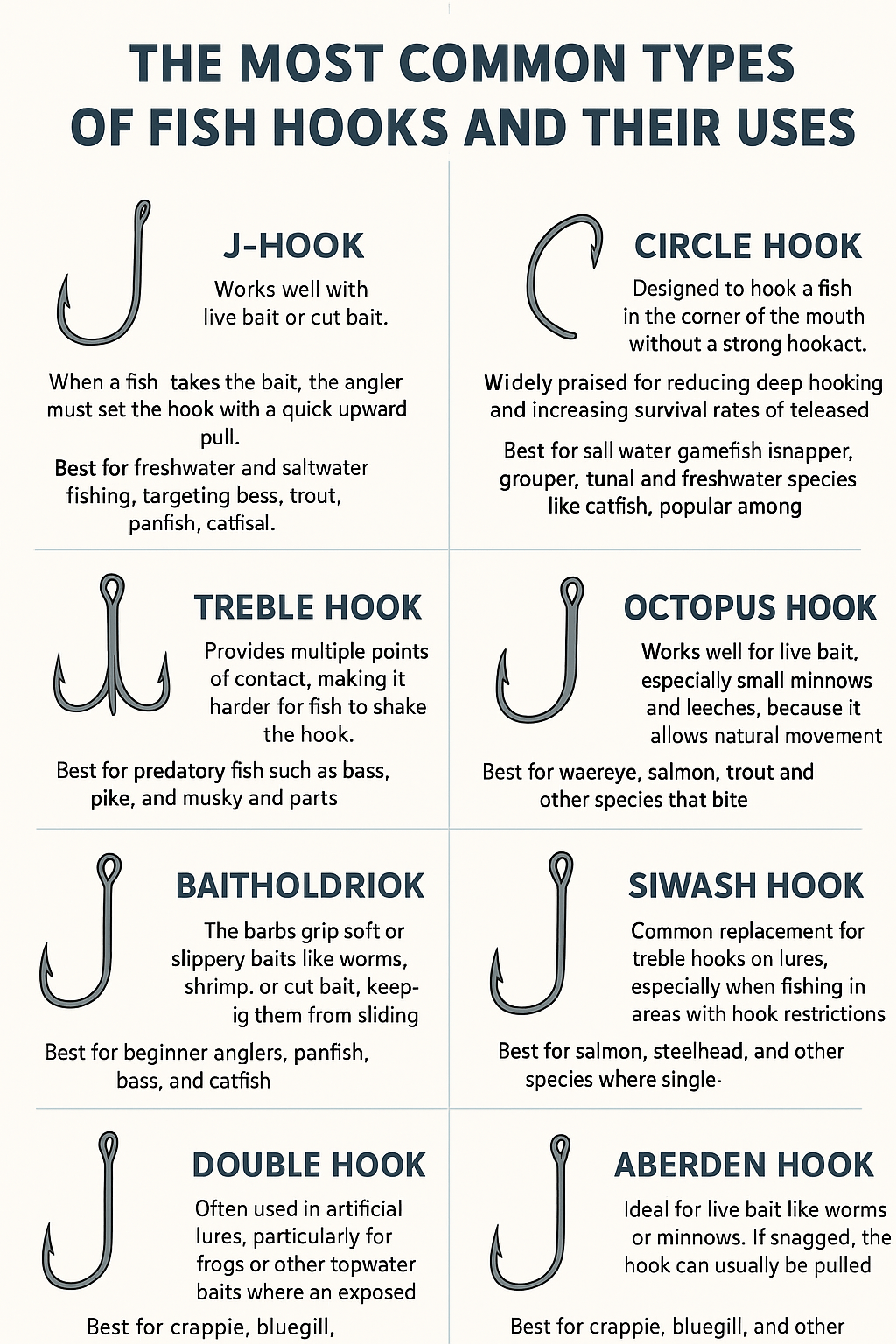
1. J-Hook
- Description: Shaped like the letter “J,” this is the most traditional hook style.
- Uses: Works well with live bait or cut bait. When a fish takes the bait, the angler must set the hook with a quick upward pull.
- Best For: Freshwater and saltwater fishing, targeting bass, trout, panfish, and catfish.
2. Circle Hook
- Description: Features a rounded shape where the point curves back toward the shank.
- Uses: Designed to hook a fish in the corner of the mouth without a strong hookset. Widely praised for reducing deep hooking and increasing survival rates of released fish.
- Best For: Saltwater gamefish (snapper, grouper, tuna) and freshwater species like catfish. Popular among catch-and-release anglers.
3. Treble Hook
- Description: Three hooks joined at a single shank, forming a three-pronged design.
- Uses: Provides multiple points of contact, making it harder for fish to shake the hook. Commonly attached to lures like crankbaits, spoons, and topwater plugs.
- Best For: Predatory fish such as bass, pike, and musky.
4. Octopus Hook
- Description: Short-shank hook with a wide gap and slightly curved-in point.
- Uses: Works well for live bait, especially small minnows and leeches, because it allows natural movement.
- Best For: Walleye, salmon, trout, and other species that bite delicately.
5. Baitholder Hook
- Description: Looks like a standard J-hook but has barbs on the shank.
- Uses: The barbs grip soft or slippery baits like worms, shrimp, or cut bait, keeping them from sliding off.
- Best For: Beginner anglers, panfish, bass, catfish.
6. Siwash Hook
- Description: A single hook with a long shank and an open eye for easy attachment.
- Uses: Common replacement for treble hooks on lures, especially when fishing in areas with hook restrictions.
- Best For: Salmon, steelhead, and other species where single-hook setups are required.
7. Double Hook
- Description: Two hooks joined at the shank, angled slightly apart.
- Uses: Often used in artificial lures, particularly for frogs or other topwater baits where an exposed treble might snag.
- Best For: Largemouth bass and pike fishing.
8. Aberdeen Hook
- Description: Thin, long-shank hook designed to bend under pressure instead of breaking.
- Uses: Ideal for live bait like worms or minnows. If snagged, the hook can usually be pulled free.
- Best For: Crappie, bluegill, and other panfish.
Choosing the Right Hook
The best hook depends on:
- Target species – Bigger fish require stronger hooks with wider gaps.
- Bait type – Worms, minnows, and artificial lures each pair better with different hooks.
- Fishing style – Catch-and-release anglers often prefer circle hooks, while lure anglers lean toward trebles or siwash hooks.
To the novice angler all of these hooks may look the same, but knowing the difference and understanding the fish you are trying to catch will greatly improve your odds of catching more fish.


 Hunters Foundry
Leave a comment